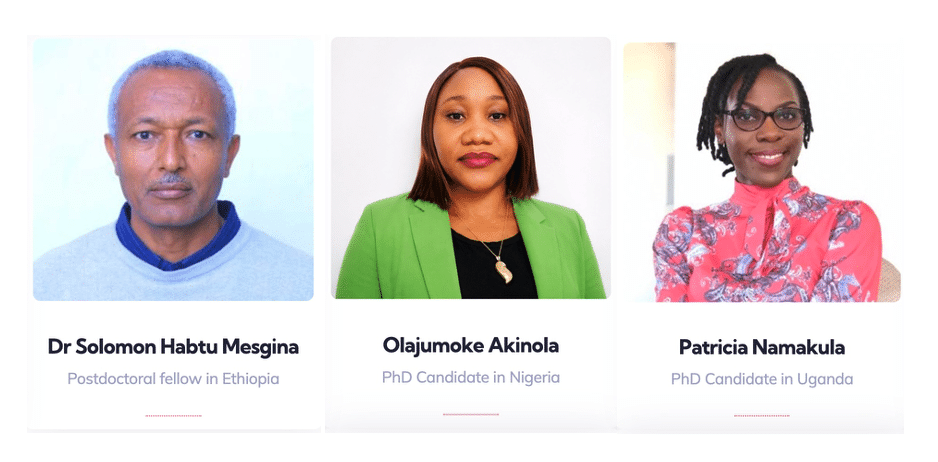
The African Nature Futures lab welcome three new team members to our interdisciplinary research community!
by Jessica Thorn, Imperial College London, University of Namibia
October 2026
I would like to welcome a postdoc and two PhD students to the African Nature Futures Lab at the Centre for Environmental Policy at Imperial College London!
Meet Dr Solomon Haptu Mesgina, who is a Ethiopian postdoc in the Centre for Environmental Policy at Imperial College London, supported by the Cara fellowship. He is also an academic in the Department of Land Resource Management and Environmental Protection at Mekelle University, Tigray, Ethiopia. Since 2000, he has been engaged in teaching, conducting research, and delivering community services in the fields of irrigation and water resource management. His current research focuses on the optimisation of smallholder farmers’ irrigation scheduling for food security in Madagascar, Zimbabwe and Tanzania. The project measures irrigation water use and collects data on irrigation practices, crop yields, soil characteristics and meteorological conditions across irrigation using FAO CROPWAT 8 to determine optimal crop water requirements and irrigation schedules. It compares farmers’ existing practices with model-optimised schedules and combines key informant interviews, focus group discussions and secondary data to assess potential improvements in water-use efficiency, crop yields, irrigated area coverage and food security. This a partnership with the University of Zimbabwe, University of Antananarivo and Imperial College London. Beyond his teaching and research roles, Dr. Solomon has served as Head of the Department of Land Resource Management and Environmental Protection (2001–2002; 2005–2006), Postgraduate Coordinator of the same department (2008–2016), and PhD Coordinator of Water Resource Development and Management program at the Institute of Water and Environment, Mekelle University (2020–2025). In addition to his academic responsibilities, Dr. Solomon has contributed to various research and consultancy projects. His most recent engagements include: leading of the Irrigation Water Use and Governance team under the Basin Management Support for Resilient, Inclusive Growth and Harmonized Transformation for the National IWRMP of Ethiopia (BRIGHT) at the Tseba-Ayna catchment in Tigray (2025–present), Co-Coordinating of the Smallholder Farming Families Adapt African Alluvial Aquifers to Strengthen Their Own Resilience (A4Store) project (2024–present), Coordinating of the AICS RESILIENT Project titled “Damage Assessment and Identification of Interventions for Selected Irrigation Schemes in Tigray, Ethiopia”, funded by OXFAM (2025–present), and contributing as a team member of the preparation of the Irrigation Sector Strategic Plan for Tigray Regional State (2025–present).
Meet Olajumoke Akinola, who is a Nigerian PhD researcher with over 14 years of professional experience in applying GIS, remote sensing, and Earth observation technologies. Her research interests focus on agricultural sustainability, food security, climate adaptation, and environmental management. Her PhD research at the Centre for Environmental Policy, Imperial College London, investigates the relationships between forest depletion, local climate variability, and food security in Abuja’s gazetted forest reserves, Nigeria. This work will integrate geospatial analysis, climate data, and socioeconomic research. Before moving to Imperial, she served as the Chief Scientific Officer in the Natural Resources Management Division at the National Space Research and Development Agency in Nigeria. She coordinated research activities, conducted field-based data collection and validation, and facilitated capacity-building programmes for agricultural extension agents, students, researchers, and policymakers. She has also contributed to national and international collaborative projects such as the Nigeria CropWatch Innovative Project, in collaboration with the Aerospace Information Research Institute, China, United Nations Conference on Trade and Development, Alliance of National and International Science Organisations for the Belt and Road Regions, and NASA Harvest. She is the lead author of a publication titled “Spatial prioritisation of agroforestry for carbon sequestration using GIS-based multi-criteria decision analysis,” a Handbook of Carbon Negative Footprint Materials by Springer Nature, and co-authored eight papers on agricultural mapping, food systems, ecotourism, and carbon emissions.
Meet Patricia Namakula, who is a Ugandan PhD candidate at the Centre for Environmental Policy, Imperial College London. Her research examines how systems thinking can inform integrated strategies to reduce post-harvest food loss, improve waste management, and strengthen food security and resource recovery in Uganda. Working with market vendors, smallholder farmers, local authorities, waste management agencies, and policymakers, she identifies practical interventions to reduce loss of high-value perishable crops, including bananas, tomatoes, and avocados. Before embarking on her doctorate, Patricia spent more than eight years as Head of Research at the Centre for Multilateral Affairs, a think tank dedicated to advancing African and Global South perspectives in domestic, regional, and international policy discourses. Her research has addressed a range of geopolitical and environmental challenges, including the ecological impacts of refugee settlements in Eastern Uganda, Uganda’s contribution to regional peace support operations, and the governance frameworks and gender dimensions of AI policy in Uganda. Patricia holds a Bachelor (Hons) of Journalism and Communications and master’s degree in international relations and Diplomatic Studies from Makerere University, as well as a Postgraduate Diploma in Public Policy and Governance from the Uganda Management Institute. Growing up in Uganda, Patricia witnessed the paradox of widespread food insecurity alongside substantial losses of fresh produce in local markets. Seeing families struggle to secure even one meal a day while edible food was routinely discarded inspired her commitment to building more sustainable, equitable food systems.