
The Role of Green-Blue Infrastructure in Informal Settlements, Namibia
By Johannes Andreas, PhD student at the University of Namibia, Department of Environmental Sciences, Namibia
December 2024
A walk through Namibia’s informal settlements tells a powerful story
In Namibia, the rapid expansion of informal settlements in burgeoning towns and cities is occurring at an unprecedented pace. These areas are marked by their resilience, creativity, and survival tactics. Nonetheless, they also grapple with significant environmental issues, such as extreme temperatures, flooding, competition for natural resources, pollution, and inadequate sanitation. A crucial yet often overlooked remedy in these communities is green-blue infrastructure (GBI), which encompasses elements like trees, gardens, open spaces, wetlands, streams, and rivers that are integral to daily life. In many instances, green-blue infrastructure transcends mere aesthetics or natural beauty; it serves as a vital lifeline.
What is Green-Blue Infrastructure, and why does it matter?
Nature-based solutions are widely acknowledged as effective methods for enhancing human well-being while safeguarding the environment (Kiddle et al., 2021). A key nature-based solution is green-blue infrastructure, which involves a connected network of green spaces and water systems that support ecosystem functions, ensure clean air and water, and benefit both humans and wildlife (Kamjou et al., 2024). Green-blue infrastructure can enhance mental health, bolster food security, and support livelihoods (ICLEI, 2021). Research also indicates that the health benefits of green spaces in countries of the Global South are comparable to those in the Global North (Hunter et al., 2023). Nevertheless, in Namibia, numerous informal settlements lack green-blue infrastructure due to inadequate spatial planning and insufficient service provision by local authorities. Furthermore, the excessive harvesting of vegetation and pollution of rivers and drainage systems continue to pose threats to local ecosystems.
Windhoek and Rundu: Growing urban centres under pressure
This blog is based on fieldwork conducted in Windhoek and Rundu, two of Namibia’s fastest-growing urban centres. Windhoek, the capital and economic centre of Namibia, is undergoing rapid urbanisation and a rise in informal settlements. The city’s population is expected to surpass 431,000, with an annual growth rate of about 4% (Bebi & Iyambo, 2025). Rundu, the administrative centre of Kavango East, is situated along the Kavango River (Okavango) and is roughly 716 km from Windhoek. This town is witnessing substantial population growth, with an annual increase of 5.4%, and its population is projected to be nearly 120,000 (Danielsson, 2016; Kwaambwa et al., 2024; Ndumba et al., 2021; Negussie et al., 2024; NSA, 2011). Rundu is increasingly being recognised as an urban area with potential for industrial development (Negussie et al., 2024). Both towns share a common situation: urban expansion is happening rapidly, but the development of environmental infrastructure is lagging.
My fieldwork experience: Listening to communities directly
From August to October 2025, I conducted a household survey and interviews with key informants in four informal settlements under the jurisdiction of the City of Windhoek and the Rundu Town Council. I collaborated with two research assistants and collected data using the Kobotoolbox. The research took place in the following areas: Peter Nanyembe, Okahandja Park A, Sikanduko, and Tuhingireni. These settlements have varied development histories. Peter Nanyembe and Tuhingireni have not yet undergone upgrades, whereas Okahandja Park A and Sikanduko have seen partial upgrades through a brownfield/in-situ upgrading initiative supported by the Shack Dwellers Federation of Namibia (SDFN) in collaboration with local authorities. This fieldwork provided firsthand evidence of nature-based solutions and helped identify the daily challenges faced by both the environment and the residents.
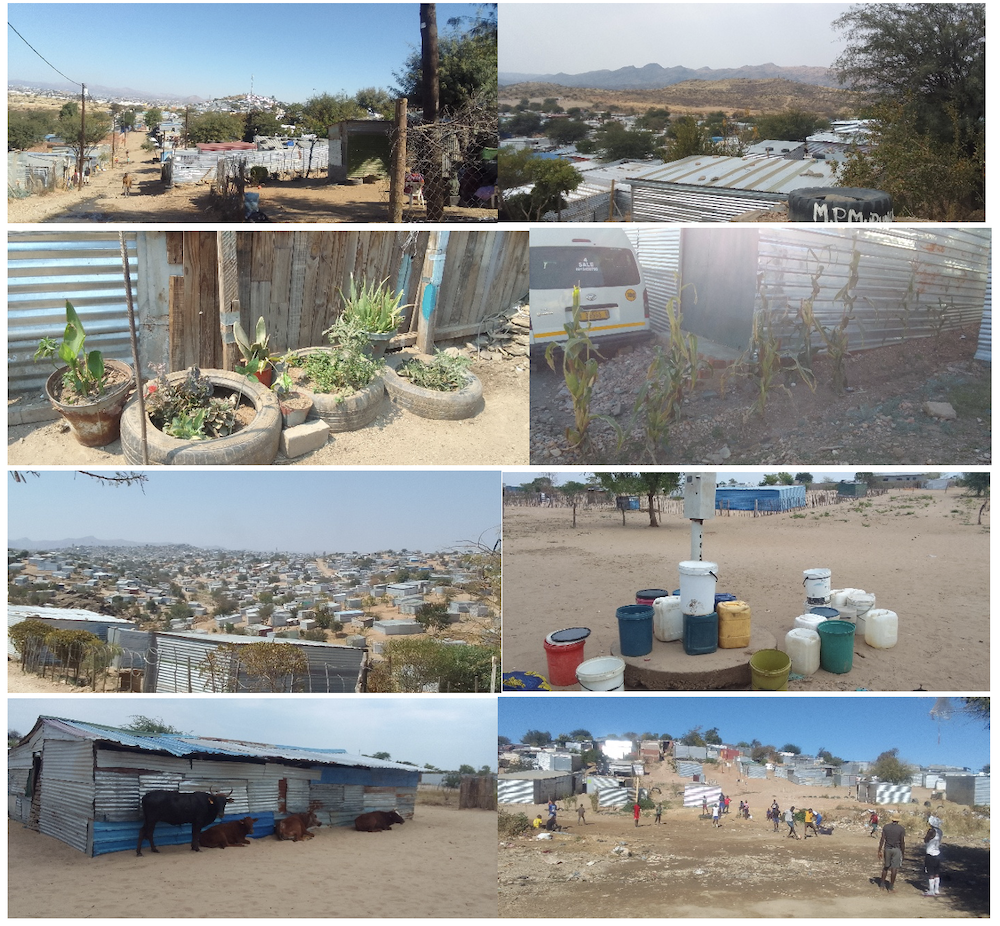
Image of Okahandja Park A informal settlement (top left and right), pot plants in tyres (middle left), a maize (Zea mays) garden (middle right) and an image of Peter Nayemba’s informal settlement (bottom left), communal water tap surrounded by water containers (middle right), cattle roaming around (bottom left) and boys playing football in the riverbed (bottom right)
Green solutions: What residents are already doing
Despite the challenging living conditions, numerous residents are making concerted efforts to cultivate greener areas around their homes. During my visits, I noticed several local initiatives, such as backyard gardens, fruit and shade trees, potted plants, gardening in tyres, vertical and rooftop greening, small household nurseries and seedlings. These activities go beyond mere gardening hobbies; they are essential survival strategies that enhance food security, provide shade, and improve overall well-being. At the same time, many informal settlements lack safe communal spaces. Children were frequently observed playing soccer and netball on sandy and rocky streets, underscoring the pressing need for recreational parks and playgrounds. Additionally, residents face recurring threats such as livestock damage, flooding, windstorms, fires, and hailstorms, all of which endanger both property and livelihoods.
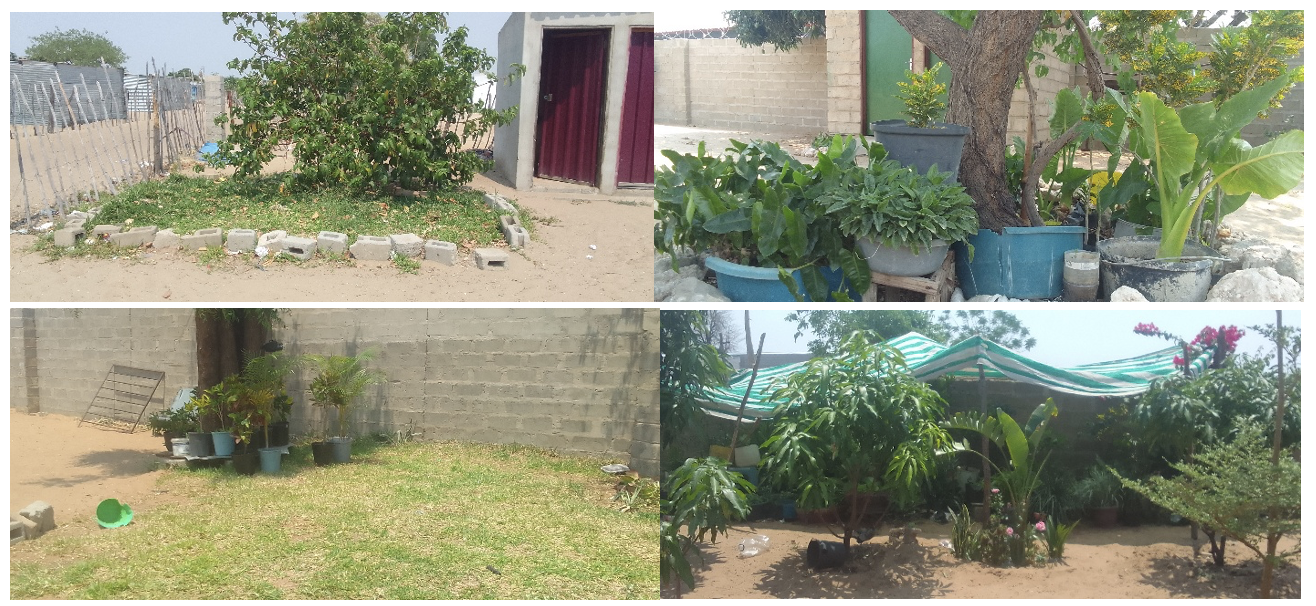
Lawn grass with a guava tree (top left), and potted plants under the terminalia sericea tree (top right) and Neem tree with lawn and potted plants (bottom left), greenhouse, and mango (bottom right)
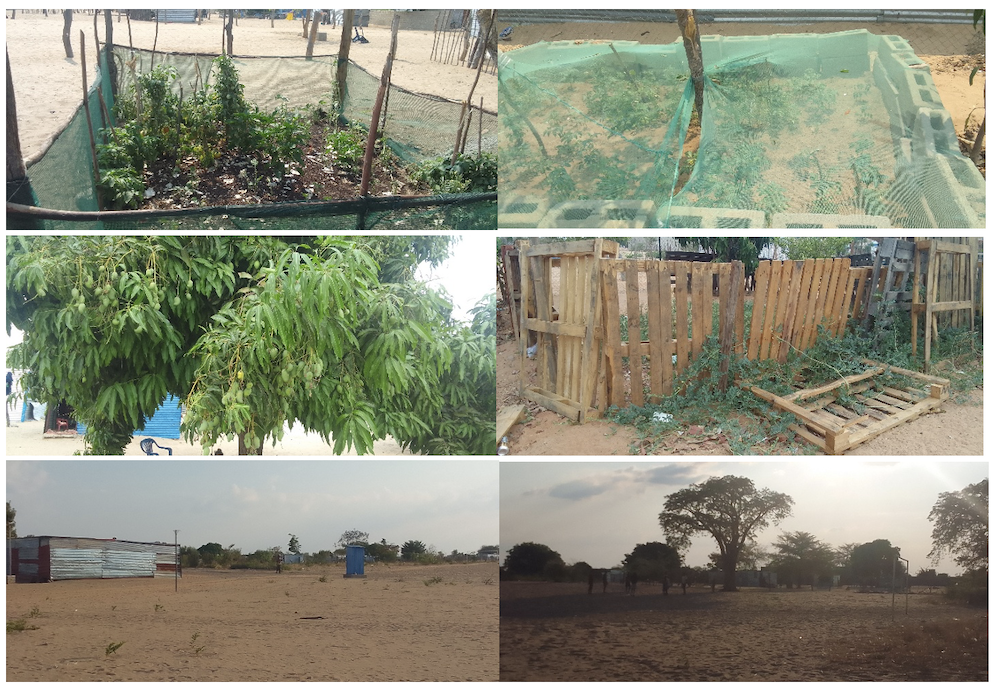
Backyard gardens with tomatoes (top left), spinach (top right), a fruit tree (mango tree) (middle left), watermelon (middle right), a sandy netball court (bottom left) and a football field (bottom right)
Ecosystem services: The benefits people receive from nature
Humans gain numerous advantages from nature, known as ecosystem services (Misiune et al., 2022). These advantages are largely reliant on ecological functions, the structure of the landscape, and the overall health of the environment. Ecosystem services are typically categorised into provisioning, cultural, regulatory, and supporting services (Kisetu et al., 2022). In Namibia, communities in informal settlements depend significantly on nearby aquatic and forest ecosystems for essentials such as food, water, firewood, timber, medicinal resources, and materials for wood carving (Thorn et al., 2021). Additionally, green-blue infrastructure enhances resilience by aiding in microclimate regulation, food production, air purification, grey water filtration, and psychosocial health (Wijesinghe & Thorn, 2021). Trees play a crucial role by offering services like cooling, carbon dioxide absorption, and air quality enhancement (ISCAPE, 2018).
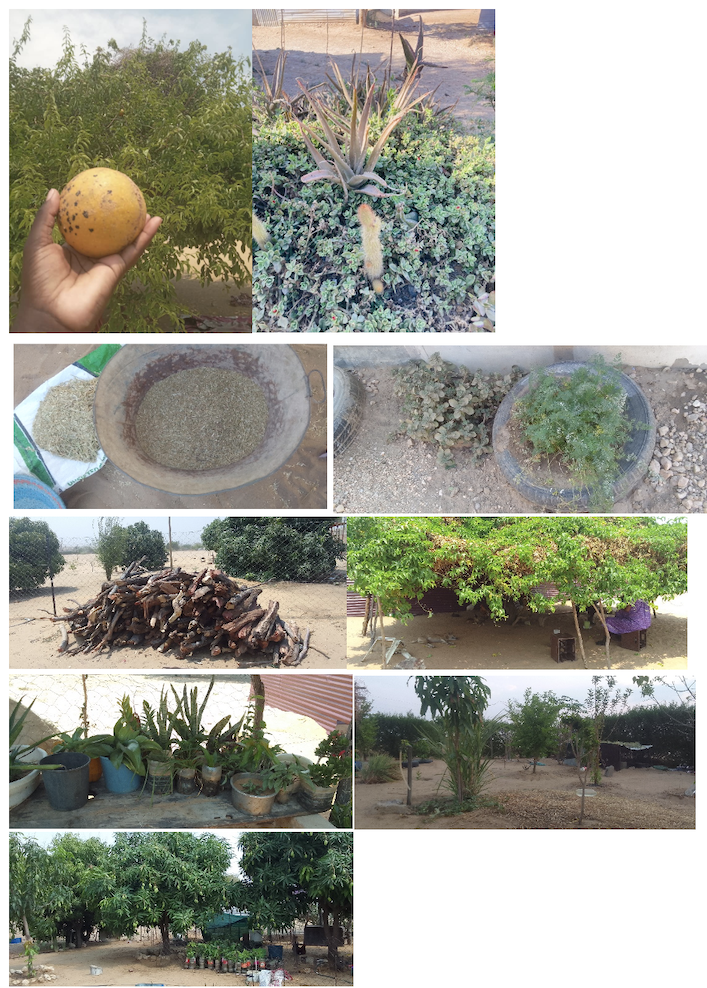
Monkey orange fruit is a delicacy for the locals (top left), Aloe vera plant (medicine) (top right), five-year spinach seed prepared for selling at the market (middle left), corrts planted in tyre (middle right), firewood (middle left), granadilla shrub (middle right), potted plants for decoration (bottom left) and a household yard fenced with Dodoneae viscosa shrub, orchard plantation, with lemon grass (bottom right) and tree seedlings and mango tree plantation (bottom left)
What residents told me: The most valued benefits of GBI
Household surveys and key informant interviews revealed numerous benefits associated with green-blue infrastructure. These benefits include:
- Provision of fruits and vegetables
- Soup, juice and cooking oil
- Medicinal plants
- Firewood
- Timber and wood carving resources
- Livestock fodder
- Shade and cooling
- Recreational and cultural value
- Social cohesion
- Stormwater filtration and nutrient regulation
- Fresh water
This shows that green-blue infrastructure is deeply connected to livelihoods. In many households, nature is not optional; it is essential.
Ecosystem Disservices: When Nature Becomes a Risk
While green-blue infrastructure offers numerous benefits, residents have also highlighted the adverse effects they face. These negative impacts, often exacerbated by inadequate settlement planning and insufficient infrastructure, include large trees potentially falling and damaging homes or roots, causing structural harm. Dense vegetation is sometimes perceived as a security threat, offering concealment for criminals or habitats for dangerous snakes, flies, and mosquitoes. Water systems are a significant concern, with many areas suffering from poor sanitation, leading to contaminated riverbeds and water channels. People may relieve themselves near water sources, and grey water from homes and industries often flows through streets, stagnating and emitting strong odours. Stagnant water fosters mosquito breeding, heightening malaria risks. Residents also worry about the rapid spread of diseases like typhoid, hepatitis, pneumonia, and other infections in unsanitary conditions. Waste disposal sites near homes pose additional hazards, and in some instances, residents burn accumulated waste, releasing smoke and pollutants that degrade air quality and health. Some participants noted that leaves and grass can increase cleaning duties, making certain green spaces seem more like a “problem” than an advantage.
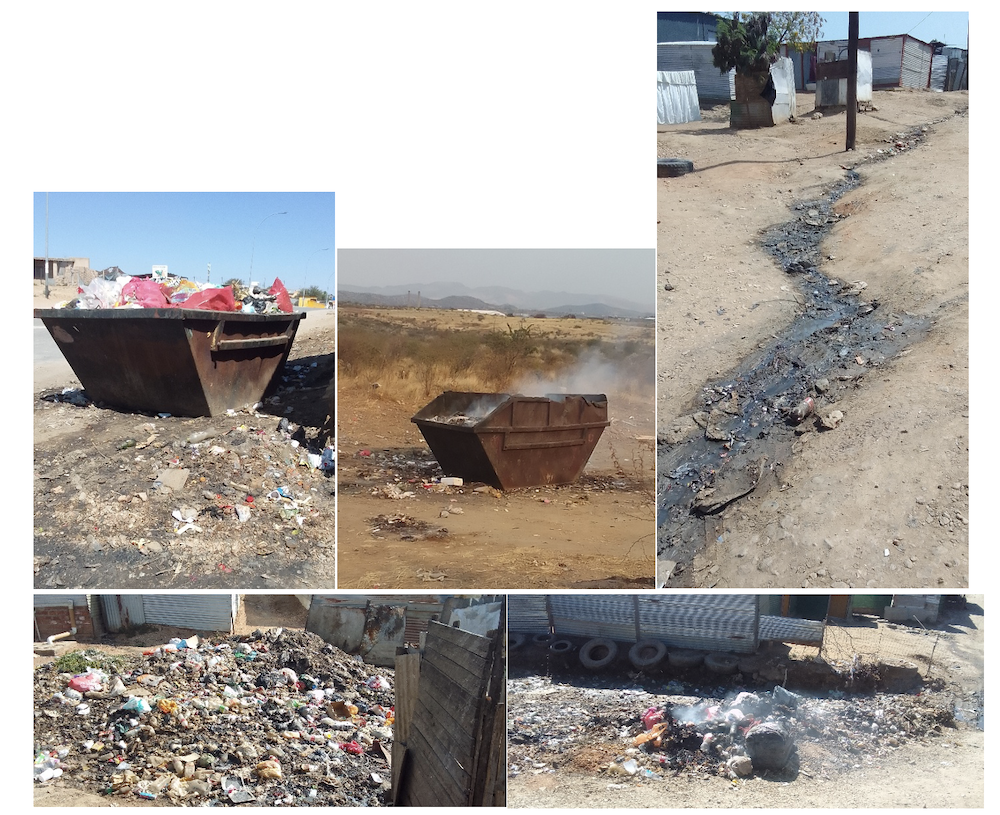
Rubbish/garbage accumulation at the dumping zone (skip bin) causes bad odour, flies and a health risk (Top left & bottom left), burning of waste pose health risk to the surrounding environment and residents (top middle & bottom right), grey water running into the street (top right)
Why this matters: GBI is not a luxury; it is survival infrastructure
Evidence gathered from Windhoek and Rundu indicates that green-blue infrastructure is already essential in informal settlements. It contributes to food security, regulates the microclimate, provides shade, supports livelihoods, and enhances cultural practices and community well-being. Nevertheless, environmental degradation, pollution, and inadequate sanitation continue to erode these advantages and heighten risks.
What can be done? Key recommendations for sustainable informal settlements
To enhance green-blue infrastructure and bolster community resilience, informal settlements require more robust planning and environmental backing. Based on observations from fieldwork, the following measures are crucial: Preserve existing trees and natural vegetation rather than removing them entirely. Enhance waste management systems to prevent dumping and burning near residential zones. Upgrade sanitation infrastructure to minimise water pollution and health risks. Encourage community gardens and small-scale urban agriculture. Create recreational parks and playgrounds for children. Improve drainage and riverbed management to mitigate flooding and stagnant water. Support local greening efforts through partnerships with municipalities and NGOs.
Conclusion
Green-blue infrastructure holds the promise of transforming informal settlements into communities that are both healthier and more resilient. In places like Windhoek and Rundu, it is evident that residents are already making efforts to cultivate green spaces within their homes, despite receiving minimal support. However, for green-blue infrastructure to fully realise its potential, it must be acknowledged as a crucial component of urban development rather than an afterthought. Safeguarding and revitalising green and blue areas in informal settlements is not only an environmental imperative but also a public health requirement and a crucial step towards achieving sustainable urban resilience in Namibia.
References
Bebi, B. B., & Iyambo, S. N. (2025). A study of spatial and temporal variation of urban population growth in Windhoek, Namibia. Environmental Research Communications, 7(5). https://doi.org/10.1088/2515-7620/add3d2
Danielsson, E. (2016). Crossing Borders, Creating Boundaries: Identity Making of the Angolan Diaspora Residing in the Border Town of Rundu, Northern Namibia.
Hunter, R. F., Nieuwenhuijsen, M., Fabian, C., Murphy, N., Hara, K. O., Rappe, E., Sallis, J. F., Lambert, E. V., Lucia, O., Duenas, S., Sugiyama, T., & Kahlmeier, S. (2023). Viewpoint Advancing urban green and blue space contributions to public health. The Lancet Public Health, 8(9), e735–e742. https://doi.org/10.1016/S2468-2667(23)00156-1
ICLEI. (2021). This is a repository copy of Dryland nature based solutions for informal settlement upgrading schemes in Africa. https://eprints.whiterose.ac.uk/
ISCAPE. (2018). Guidelines to Promote Passive Methods for Improving Urban Air Quality in Climate Change Scenarios (Issue 7). https://www.iscapeproject.eu/wp-content/uploads/2017/09/iSCAPE_D1.2_Guidelines-to-Promote-Passive-Methods-for-Improving-Urban-Air-Quality-in-Climate-Change-Scenarios.pdf
Kamjou, E., Scott, M., & Lennon, M. (2024). Green infrastructure inequalities in informal settlements. Habitat International, 147(September 2023), 103058. https://doi.org/10.1016/j.habitatint.2024.103058
Kiddle, G. L., Bakineti, T., Latai-Niusulu, A., Missack, W., Pedersen Zari, M., Kiddle, R., Chanse, V., Blaschke, P., & Loubser, D. (2021). Nature-Based Solutions for Urban Climate Change Adaptation and Wellbeing: Evidence and Opportunities From Kiribati, Samoa, and Vanuatu. Frontiers in Environmental Science, 9(October), 1–11. https://doi.org/10.3389/fenvs.2021.723166
Kisetu, E., Hakimu, B., Elias, W., Madulu, P., & Anatory, C. (2022). Exploring urban green packages as part of Nature-based Solutions for climate change adaptation measures in rapidly growing cities of the Global South. 310(October 2021).
Kwaambwa, E. L. C., Amwele, H. R., Kwaambwa, H. M., & Letsoalo, S. S. (2024). Exploring the awareness and value chain of Moringa oleifera for sustainable livelihoods: A case study of Sauyemwa West and Kaisosi East Areas in Rundu, Kavango East Region, Namibia. Asian Journal of Agriculture and Rural Development, 14(3), 79–86. https://doi.org/10.55493/5005.v14i3.5161
Misiune, I., Depellegrin, D., & Vigl, L. E. (2022). Human-Nature Interactions: Exploring Nature’s Values Across Landscapes. In I. M. D. D. L. E. Vigl (Ed.), Human-Nature Interactions. Springer.
Ndumba, S., Shikangalah, R., & Becker, F. (2021). Towards understanding the role of informal cross-border trading at Rundu-Calai bridgehead, Namibia. Journal of Namibian Studies, 29, 7–25.
Negussie, K. G., Gebrekidan, B. H., Wyss, D., & Kappas, M. (2024). Assessing land suitability for leguminous crops in the okavango river basin: A multicriteria and machine learning approach. International Journal of Applied Earth Observation and Geoinformation, 135(November), 104284. https://doi.org/10.1016/j.jag.2024.104284
NSA, N. S. A. (2011). Profile-of-Namibia.pdf.
Thorn, J. P. R., Aleu, R. B., Wijesinghe, A., Mdongwe, M., Marchant, R. A., & Shackleton, S. (2021). Landscape and Urban Planning Mainstreaming nature-based solutions for climate resilient infrastructure in peri-urban sub-Saharan Africa. Landscape and Urban Planning, 216(January), 104235. https://doi.org/10.1016/j.landurbplan.2021.104235
Wijesinghe, A., & Thorn, J. P. R. (2021). Governance of Urban Green Infrastructure in Informal Settlements of Windhoek , Namibia. 1–25.
