
Feedback and validation workshop on urban green infrastructure in Antananarivo
By Rui Han, PhD student
Department of Environment and Geography, University of York
January 2025
One of the most pressing issues facing humanity in Antananarivo is the escalation of urbanization and population growth that estimated at 4 million in 2024 and projected to double by 2050. With climate change, the urban heat island effect is warming the city centre more than surrounding areas, exacerbating social and environmental vulnerabilities in both formal and informal settlements in Antananarivo.
Thus, the need to create more resilient environment is front and centre at the FLOURISH project. On the 8th of January 2025, the FLOURISH project brought a diverse group of stakeholders into a feedback workshop to explore the role of urban green infrastructure and climate change mitigation and adaptation. Dr Jessica Thorn from University of Namibia and Imperial College London, Rui Han from the University of York, Daulphin Razafipahatelo, Alivony Ravelomanantsoa, and Diamondra Ranaivoson from the University of Antananarivo set up this feedback workshop at La Résidence d’Ankerana Hotel in Antananarivo, Madagascar.

The feedback workshop of the scenarios analysis on the urban green infrastructure in Antananarivo on 8th January 2025.
The workshop brought 31 representatives from three Antananarivo’s communes: Ambohimanambola in the east, Ambohitrimajaka in the north, and Bemasoandro near the centre, aiming to foster dialogue between community leaders, farmers, business representatives, academic experts, and residents. The session served as a continuation of the FLOURISH project, building on the insights from the workshop conducted in September 2023 <insert hyperlink to other blog>.
During this feedback workshop, participants examined historical events and deeply collaborated future scenarios for 2030 and 2063, ranging from sustainable development models to unregulated growth. These historical timeline and future scenarios provided a framework for discussing the potential outcomes of current decisions on future land use, climate resilience, and economic growth.
Historical timeline
Since gaining independence in 1960, Madagascar has undergone significant agricultural and urban transformations. Agriculture was practiced in a traditional manner until the 1980s. By the 1990s and beyond, increasing rural-to-urban immigration and population growth contributed to the expansion of informal housing, leading to a rise in impervious surfaces, building density, and urban migration. As land shortages intensified, farmers faced growing pressure to increase yields. In response, the government introduced agricultural inputs, such as fertilizers and pesticides, to boost productivity. Since the 2010s, formal institutions and legal frameworks have evolved at the fokotany scale, while land-use planning implemented to improve sustainability from local to city scales.
However, climate change and natural disasters have significantly impacted Antananarivo’s land and water resources. Events such as Cyclone Geralda (1994), extreme heat (2017), regular flooding, recent droughts, and irregular seasonal patterns aggravate soil fertility loss and water scarcity.
Future scenarios
Participatory scenario planning is an effective approach for optimising land use, expanding urban forests, and promoting sustainable urban development. To anticipate the future of urban development under uncertain socio-economic context, participants from the municipalities of Bemasoandro, Ambohitrimanjaka and Ambohimanambola to co-create and feedback on four normative land use scenarios in 2063:
- a loveable future, where the future Antananarivo thrives with planned and modernized urban region, intensified agriculture zone, and equitable green infrastructure access across population groups;
- development priority scenario, characterised by profit-driven urban expansion, accompanying with loss of green infrastructure and fragmentation of agricultural land;
- a worst-case tomorrow scenario, depicting urban degradation due to massive urban extension and unsustainable conservation awareness; and
- a green awareness scenario, where large-scale reforestation and conservation convert agricultural and unused land with stagnated economic growth and traditional agricultural approach.
Participants perceived ecosystem and green infrastructure regulation services are at most beneficial in a loveable future and green awareness scenario, followed by development priority world and a worse tomorrow scenario. These scenarios narratives provide strategic insights for fostering a cooler, greener, and more equitable Future Antananarivo.
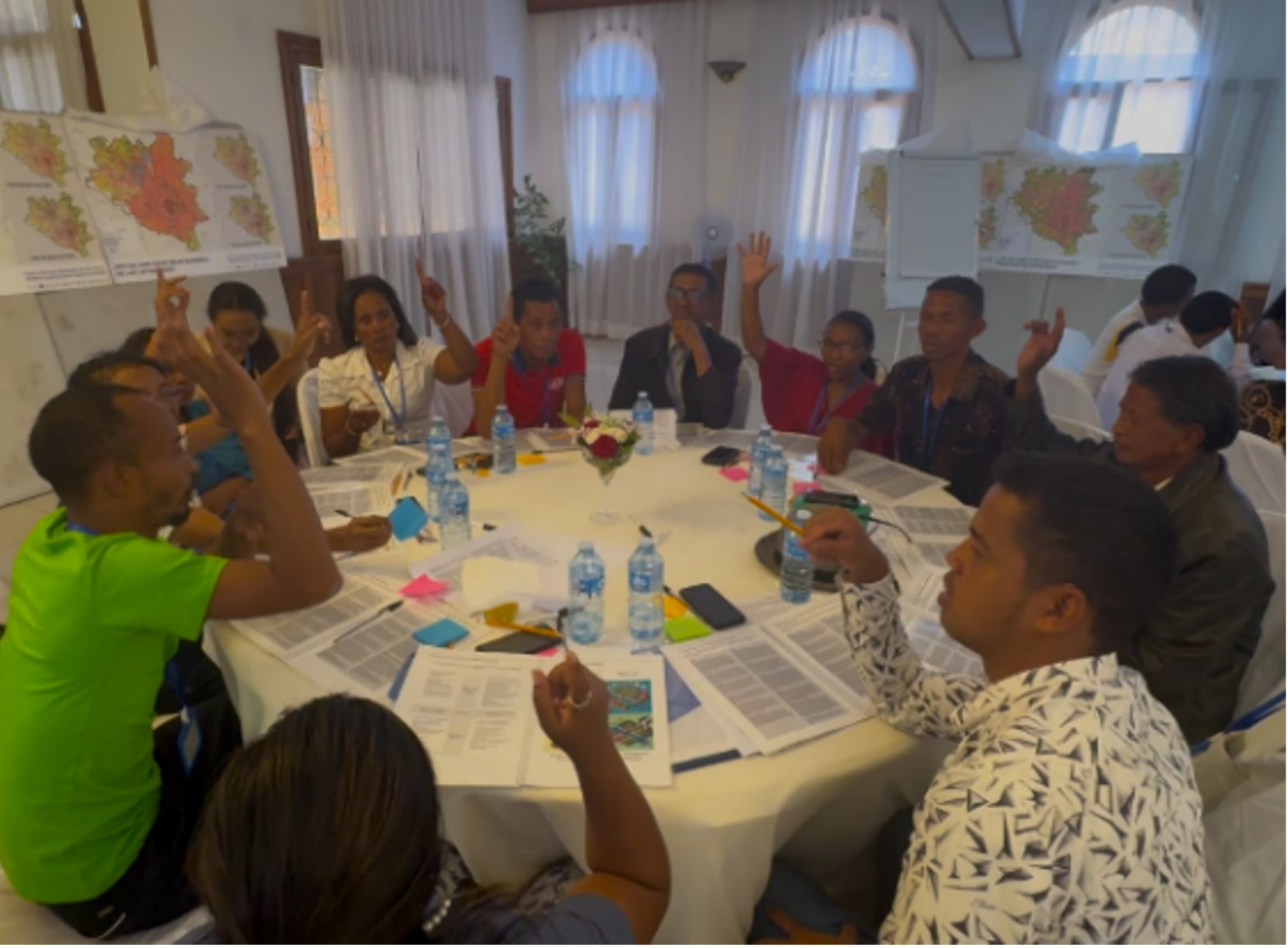
A group discussion with individuals seated at a round table
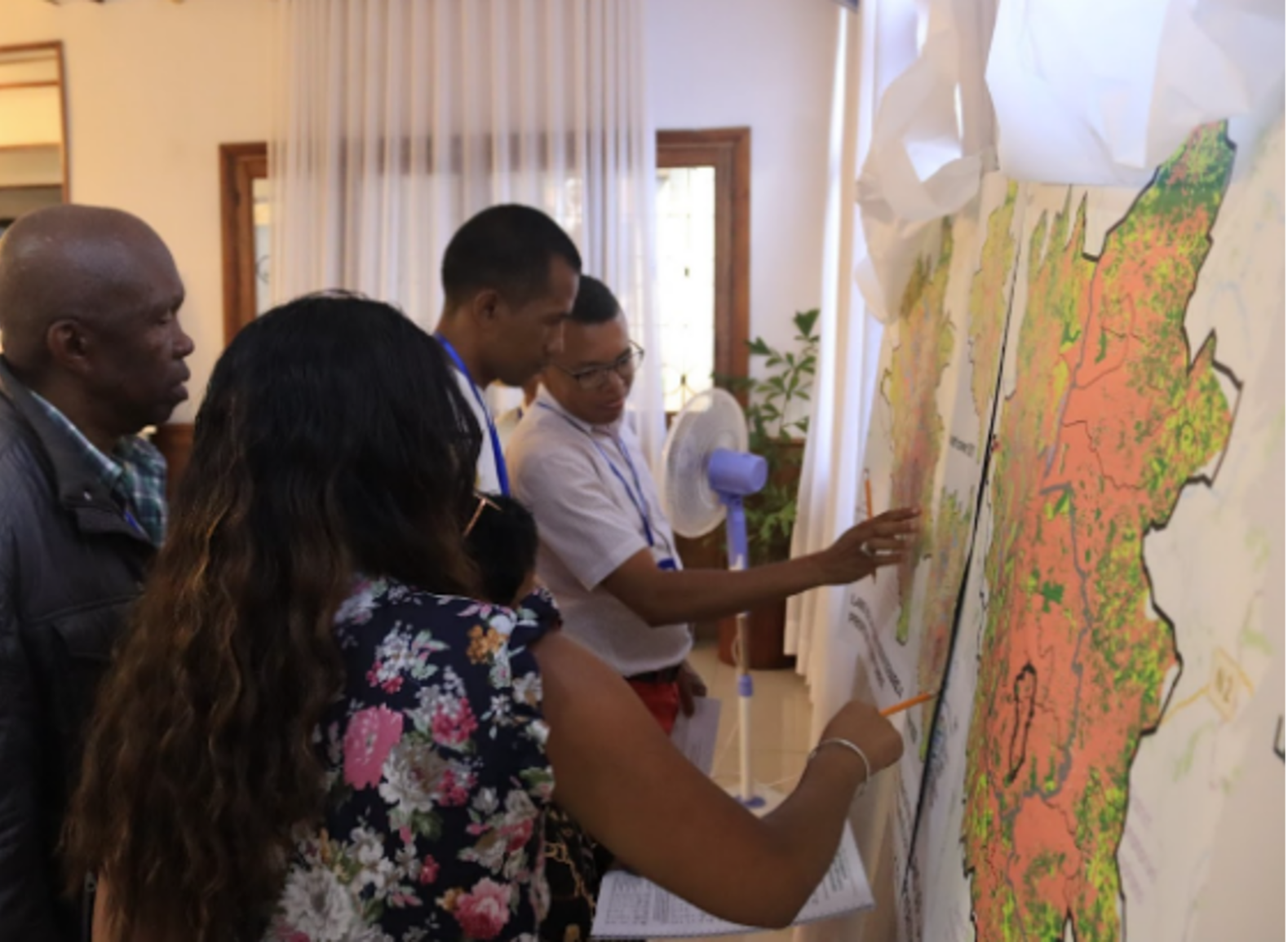
Participants actively validate the maps representing the spatially explicit future scenarios
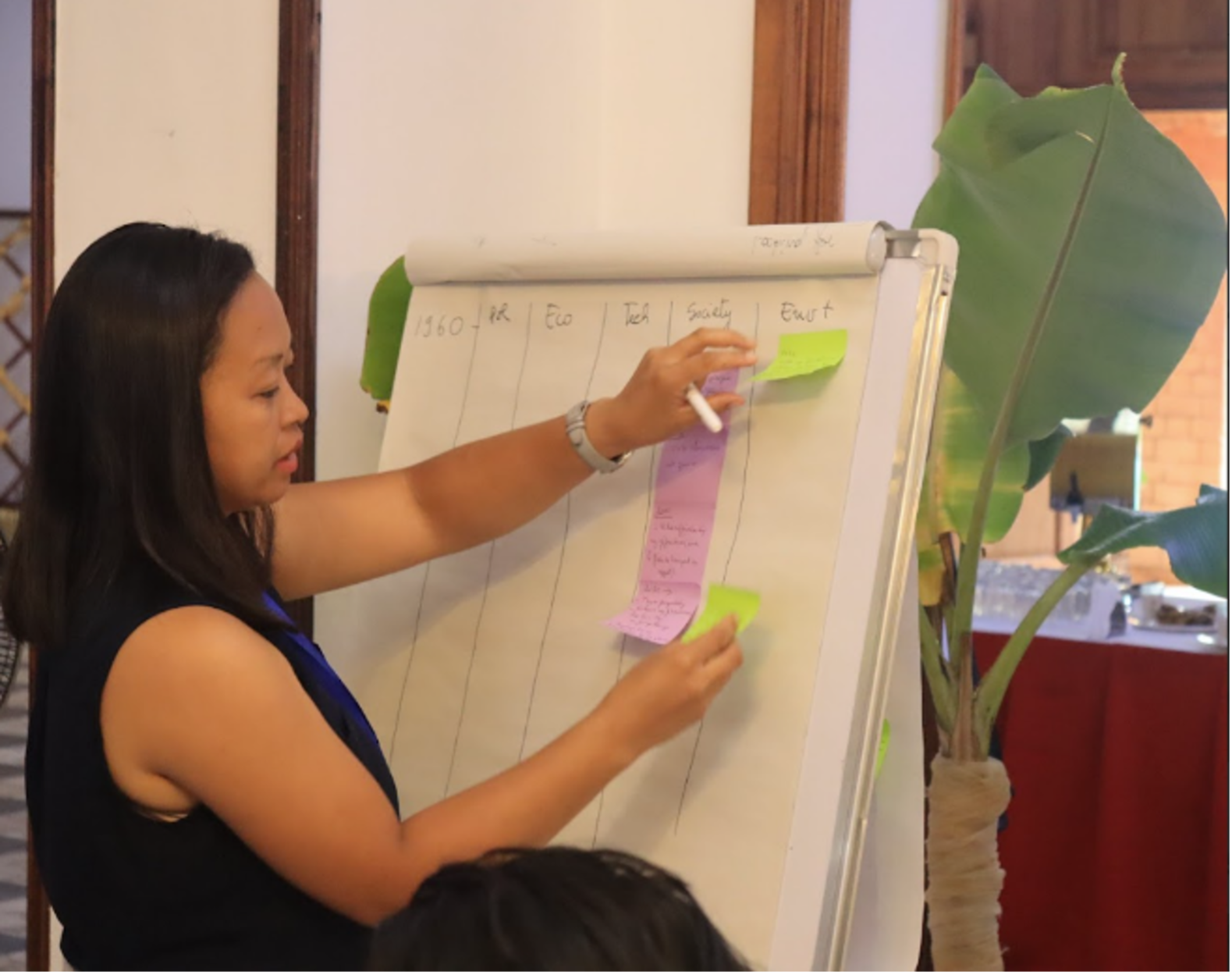
Facilitator using sticky notes to organize historical timeline
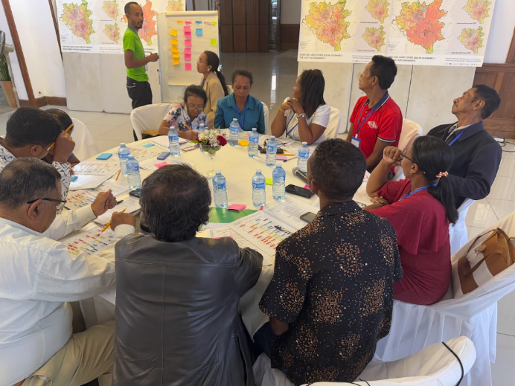
Sense making participative activity to reflect on consistency and plausibility of scenario narratives
